Feature film
The Duke of Burgundy: who is writing the script
By Rasmus Øyen, Photography writer Published 18 July 2026 Updated 18 July 2026
- Work
- The Duke of Burgundy
- Director
- Peter Strickland
- Year
- 2014
- Kind
- Feature film
The Duke of Burgundy analysis that matters starts with the inversion at the centre of the film. Peter Strickland shows a couple performing a rehearsed dominant and submissive routine, then reveals that the submissive partner writes the script, sets the schedule and requires the performance, while the dominant one is exhausted by it. The film treats that arrangement as a marriage under strain rather than as a spectacle, and its formal seriousness is what separates it from almost everything else on this subject.
Peter Strickland’s third feature is the most formally serious film on this list, and it is also the funniest. Those two facts are related. The comedy comes from treating a dominant and submissive relationship as a household job with a rota, and the seriousness comes from refusing to look away when the job gets too heavy for one of the people doing it.
Cynthia, played by Sidse Babett Knudsen, and Evelyn, played by Chiara D’Anna, live together in a large house in an unspecified part of Europe. Every character in the film is a woman. The only public activity anyone appears to have is lepidoptery: lectures, specimen cases, the study of butterflies and moths, which supplies the film with its title and with a great deal of its sound design.
The relationship runs on a written script
The film opens by showing the couple’s routine as if it were simply happening. Evelyn arrives to clean. Cynthia is cold with her, finds fault, and imposes a consequence. It plays as a scene of dominance.
Then Strickland runs it again, and again, and the machinery becomes visible. The lines Cynthia delivers were written by Evelyn. The timing is scheduled. The costume is laid out in advance. What looked like a temperament turns out to be a text, and the person we took for the author is reciting.
This is a genuinely unusual thing for a film to depict, because most screen treatments of this material stop at the tableau. Strickland is interested in the paperwork. The couple discuss bespoke furniture with the same tone a couple might use to discuss a kitchen extension. There is a safeword, and the film treats its existence as ordinary rather than as a plot device. Time is spent on the logistics of maintaining a fantasy, which is where actual relationships of this kind spend most of their time. The only comparable footage anywhere is documentary, in Kink, which films the negotiation before a scene and the check-in afterwards because that is what a working day at the company consists of, and which is at its strongest for exactly that reason.
The texture is borrowed and the borrowing is the point
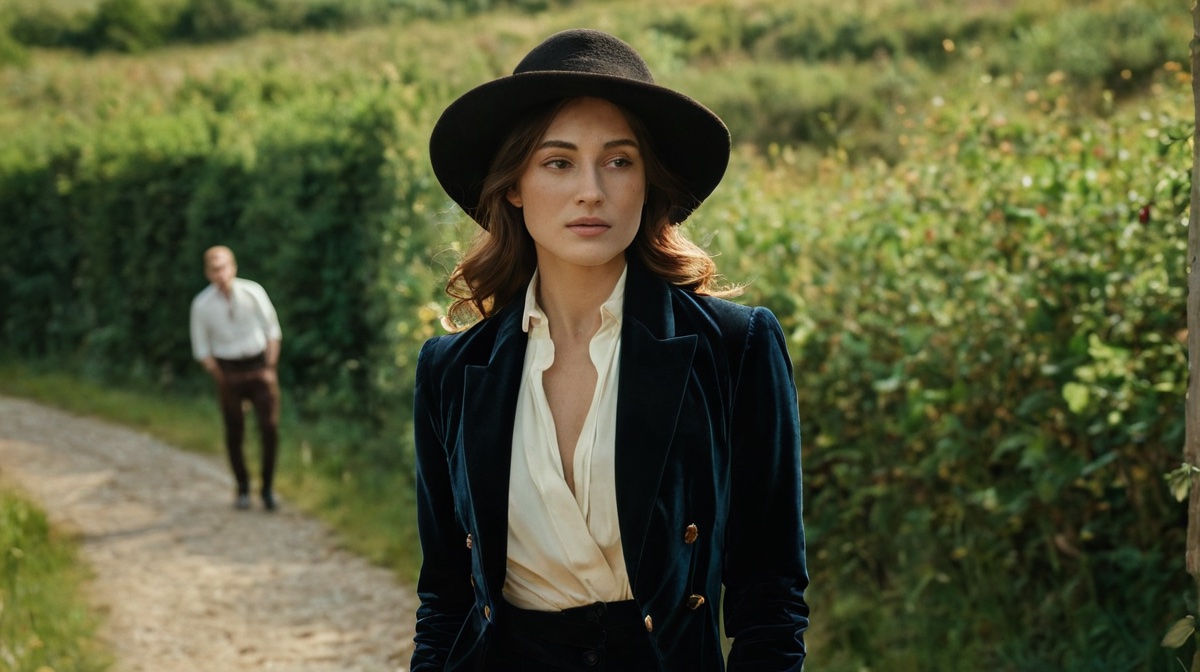
Strickland wrote the film as well as directing it, and the surface is assembled from 1970s continental genre cinema: dissolves, soft edges, an unplaceable dubbed-sounding world, credits in the style of a European erotic picture, insects on the soundtrack. Critics have consistently placed the film in that lineage, and Strickland has never hidden the reference.
The style creates an expectation, and the expectation is then withheld. A film that looks like that is supposed to deliver something. This one keeps cutting back to a woman who is tired, to a sleeping arrangement neither partner finds comfortable, and to the question of whether tonight the routine might be skipped. The gap between the promised mode and the delivered content is the film’s central formal joke, and it is played straight for the whole running time.
Nothing in it is explicit. The camera withholds where a 1970s film would show, and the withholding is deliberate: attention goes to sound, to waiting, to the second before a door closes. The result is more intimate than exposure would be, and considerably harder to do.
Authority is not where the pose puts it
Read this film with the passes set out in how to read a picture of power and the composition confirms what the plot says. Evelyn is repeatedly the lit figure, the one the camera follows, the one whose fantasy the film enters. Cynthia is often shot from behind, or in doorways, or waiting in a corridor for a cue.
The inversion has an obvious use beyond this one film. It is a working answer to the assumption that the person giving orders in a scripted dynamic is the person in charge of it. Once you have seen it staged this carefully, it becomes hard to watch Secretary without noticing how much of that relationship is also being steered from below, and hard to look at the older canon of bound figures without asking who commissioned the pose.
Where it sits
Among films that take this subject seriously, this is the one that treats it as ordinary life. Belle de Jour treats desire as an interior weather system, and the films that came after it mostly treated it as catastrophe. Strickland treats it as a couple trying to keep a shared project alive, which is both less dramatic and more recognisable.
For the wider method behind it, including the sound-led way he builds a world, see the profile of Peter Strickland.
Questions viewers ask
What is The Duke of Burgundy actually about?
Two women share a house in an unnamed European place. Every character in the film is a woman, and the only visible occupation is the study of butterflies and moths. Their relationship runs on a repeated domestic scenario with fixed lines and fixed tasks. The film follows what happens when one partner tires of performing it and the other cannot do without it. It is a film about maintenance, not about revelation.
Why does the film look like a 1970s European film?
Because the reference is deliberate. Strickland works with the surfaces of continental genre cinema from that period: soft focus, seasonal dissolves, layered sound, elaborate credit typography, an ambiguous location and no fixed date. The style raises an expectation of a certain kind of picture, and the film then declines to deliver it, which is a large part of how the joke and the seriousness coexist.
Who holds the power in the relationship?
The film is explicit about this and it is the reason people keep writing about it. Authority over the scenario belongs to the partner who appears to submit inside it. She composes the instructions, sets the calendar and judges the performance. The partner who plays the dominant role is doing labour, and the film watches the cost of that labour accumulate. The pose and the power are not in the same place.
Somebody had to work this out before it was filmed
Directors get months of rehearsal and a crew. Everyone else has a conversation and an evening.
See where it happens now