Feature film
Secretary: the office as a controlled set
By Imogen Strand, Art critic Published 21 August 2026 Updated 21 August 2026
- Work
- Secretary
- Director
- Steven Shainberg
- Year
- 2002
- Kind
- Feature film
The Secretary 2002 film is remembered because it borrowed the shape of a romantic comedy and put a consensual dominant and submissive relationship inside it. Steven Shainberg directs the material as a courtship rather than a case study, and most of the argument is made visually: an office built as an enclosed world, colour pushed past the naturalism of everything outside it, and framing that keeps coming back to hands, paper and the short distance between two people.
Before 2002, an English-language film that treated a dominant and submissive relationship as a courtship rather than as pathology, punchline or thriller device was hard to find. Steven Shainberg made one, cast it with Maggie Gyllenhaal and James Spader, and released it into art houses where it did well enough to become the reference point it still is.
The source is a short story by Mary Gaitskill, published in her 1988 collection Bad Behavior, adapted by the screenwriter Erin Cressida Wilson. Anyone who reads the story after seeing the film gets a shock. The prose version is bleak and unresolved. The film keeps the office, the typing and the red pen, then does what the story refuses to do: it lets the two people want each other.
A romantic comedy structure, borrowed on purpose
The beats are all there and all recognisable. A misfit takes a job. The employer is peculiar. Attention escalates into a private language. There is a rupture, then a public act of persistence, then a domestic ending. Swap the content and this is the architecture of a hundred studio romances.
Borrowing that architecture is the film’s boldest decision, because structure tells an audience how to read what it is seeing. Put the same events in a thriller and the employer becomes a predator. Put them in a social-realist frame and the whole thing becomes a case file. Put them in the fifteen-minute streaming comedy Netflix commissioned from Rightor Doyle seventeen years later, Bonding, and the format removes the very minutes in which two people could be shown agreeing to anything. Placed in a romance, the escalation reads as courtship, and the viewer is invited to hope it works out. Some critics considered that a sleight of hand. Others thought it the only honest way to film a relationship the participants themselves would describe as a love story.
The climax is an act of endurance carried out in the office, shot as a vigil rather than as a stunt. It occupies the slot where a genre film would put a chase to the airport, and it works for exactly the same reason: it is a public demonstration of private commitment.
Colour does the arguing
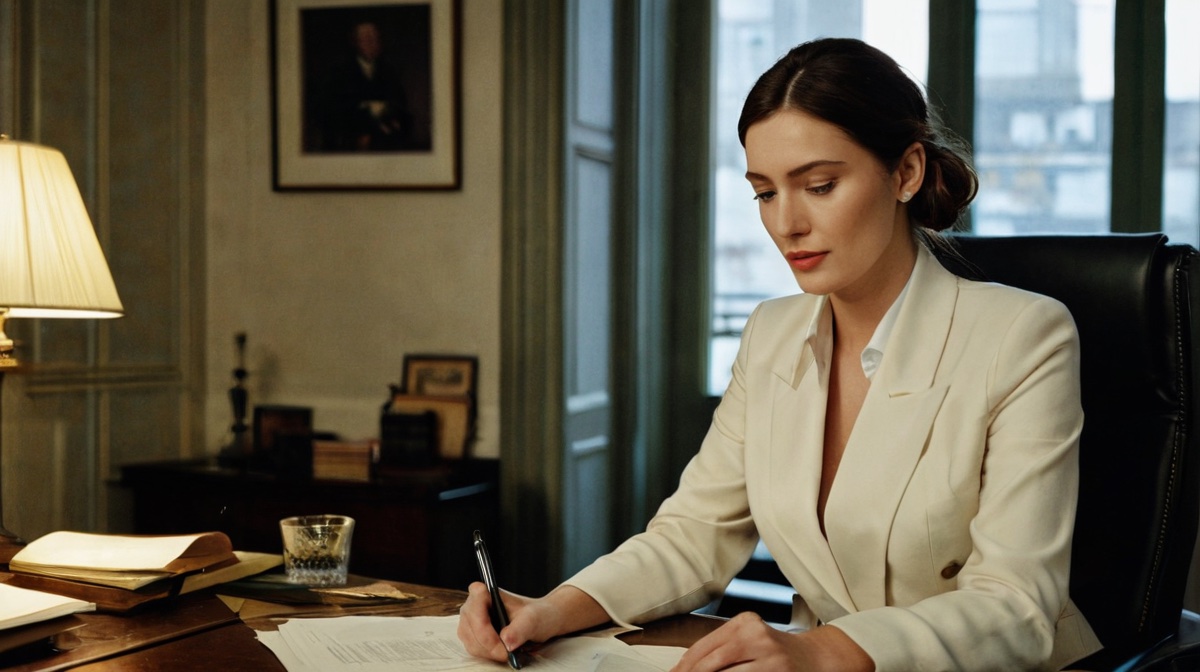
Look at the film with the sound off and the argument is still legible. The office interiors are warm, dense and saturated, with reds and greens held at a level no real workplace has ever managed. Lee’s family home and the world of her early scenes are comparatively grey and lit flat.
None of this is subtle, and it is not meant to be. The palette assigns value. It tells you where the character is alive and where she is enduring, and it does that job in the first frame of every scene, before anyone speaks. When a film is asking an audience to follow a character into territory the audience may find alarming, having the light on her side is worth a great deal of dialogue.
The framing works to the same end. Shainberg shoots a lot of hands: typing, correcting, holding paper, resting on a desk edge. The film keeps its attention on the small mechanics of the arrangement rather than on bodies, which is one reason it plays as intimate rather than as exposure. The same trick appears in the study notes on this site’s gallery, where composition is asked to carry meaning that the subject alone would not.
One set, and what it is allowed to mean
The law office is the film’s real setting, and it is treated as a designed world rather than a location. It has its own weather, its own rules of conduct, and a door that separates it from ordinary life. Everything that matters happens inside it or in reference to it.
That containment is what allows the props to become vocabulary. A typewriter. A letter with errors in it. A red pen. A drawer. Correction begins as an office procedure and becomes something else without ever changing its equipment, which is a more elegant piece of writing than the film usually gets credit for. There is no rope, no dungeon and no costume in the scenes that matter. Stationery does all of it.
Compare that to The Duke of Burgundy, where a similar dynamic is built out of a rehearsed domestic routine, or to the chateau of Story of O, where the setting is so heavily dressed that it becomes decoration. Secretary sits between the two: stylised, but furnished with things a viewer has touched.
The objection that has not gone away

The film opens with its central character leaving institutional care, and her self-harm is established early. As the relationship develops, that behaviour stops. A viewer can read this as a character finding a structure she can live inside, or as a film proposing a dominant partner as a course of treatment. Both readings are available in the material, and both have been argued by serious critics since release.
This site does not settle it. What the five-pass method in how to read a picture of power can settle is narrower and still useful: who the camera favours, whose knowledge the audience is given, and whether the composition grants the submissive figure any authority of her own. On that test the film is unambiguous. It is built around Lee’s point of view from the first scene to the last, the warm light follows her rather than her employer, and the decisive act at the end is hers alone. Whatever the plot is doing, the picture belongs to her.
Questions viewers ask
Is Secretary based on a book?
It is adapted from a short story of the same name by Mary Gaitskill, collected in Bad Behavior in 1988, with a screenplay by Erin Cressida Wilson. The story is much shorter, much colder, and does not end in romance. The adaptation keeps the office, the typing and the correction, and then builds a courtship plot the source does not contain. Gaitskill has spoken publicly about the differences between the two.
Why is the film so heavily colour graded?
Because the colour is doing structural work. The law office is warm, saturated and slightly unreal, while the world outside it looks flat and drab by comparison. The film never has to state that Lee prefers being there. The palette states it, scene after scene, and by the second act the audience reads a change of light as a change of jurisdiction.
Why do some critics object to the film?
The most durable objection is structural rather than moral. The film introduces its central character in distress and self-harming, then resolves that distress through the relationship, which can be read as presenting a dominant and submissive dynamic as a treatment for a psychiatric problem. Admirers answer that the film is a comedy about two shy people and not a clinical claim. Both readings have been argued seriously since release, and the film has never settled into one reputation.
Somebody had to work this out before it was filmed
Directors get months of rehearsal and a crew. Everyone else has a conversation and an evening.
See where it happens now