Documentary
Kink (2013): the documentary the company agreed to
By Rasmus Øyen, Photography writer Published 20 August 2026
- Work
- Kink
- Director
- Christina Voros
- Year
- 2013
- Kind
- Documentary
The Kink 2013 documentary was directed and shot by Christina Voros, produced by James Franco, and premiered at the Sundance Film Festival in January 2013. It films the working day of the pornography company Kink.com inside the San Francisco Armory: the production meetings, the negotiation before a scene, the check-in afterwards. Its difficulty is structural rather than moral. The company granted the access, the company is the subject, and the film has no means of testing anything it is told.
Christina Voros shot this film inside a building that its subject owns. The Armory on Mission Street in San Francisco is a nineteenth-century drill hall that Kink.com bought in 2006 and converted into a production facility, and almost every frame of the documentary was taken there. Whatever the picture knows, it learned as a guest.
The provenance is worth stating because it explains the tone. Franco had been working on a feature that shot at the Armory, was offered a tour of the operation, and came away wanting a documentary about it. He brought the idea to Voros, who had photographed several of his films, and she agreed after visiting the place herself. The camera therefore arrives already impressed, in the way visitors to a large and well-run facility usually are.
The film is organised as a workplace picture
What Voros made is closer to an industrial documentary than to an essay about sex. The through-line is a working day. There are production meetings and scheduling problems. There is a founder, Peter Acworth, explaining the business he built. There are staff directors describing how they plan a shoot, and performers describing what they will accept and what they will not.
The procedural footage is the reason the film survives. Before a scene, a performer sits with a director and goes through a list: this yes, this no, this only up to a point, this never. Afterwards there is a check-in, sometimes at length, sometimes with food. Very little screen material of any kind shows this part of the industry, and a film that spends its running time on the negotiation rather than the result is doing something unusual.
Voros also keeps her camera on the apparatus. She cuts away from what is being produced to the crew at the monitors, the rigging, the person holding the boom, the wait between setups. Drew Hunt, reviewing for Slant Magazine, called the result a sort of chronicle of the filmmaking process as much as an examination of hardcore pornography. That instinct is the film’s best one. By attending to the machinery, it declines to become the thing it is describing, and it stays watchable without being coy.
The compositions and the interviews disagree
Run the film past the questions in how to read a picture of power and a gap opens that the documentary never quite notices.
The interviews argue that authority belongs to the performer. She sets the terms, she can stop everything with a word, the scene exists to deliver what she agreed to. Meanwhile the images show a room of technicians arranging a body under lights they control, on a schedule they set, for a client neither she nor they will ever meet. The lit figure is the performer. The people who are spared the light are the ones running the day.
Both accounts are true. The performer really does hold a veto, and the crew really does hold everything else. A more sceptical film would have made that double structure its subject, because it is genuinely interesting and it is visible in Voros’s own footage. This one lets the interviews settle the question and moves on.
Everybody who speaks has a stake
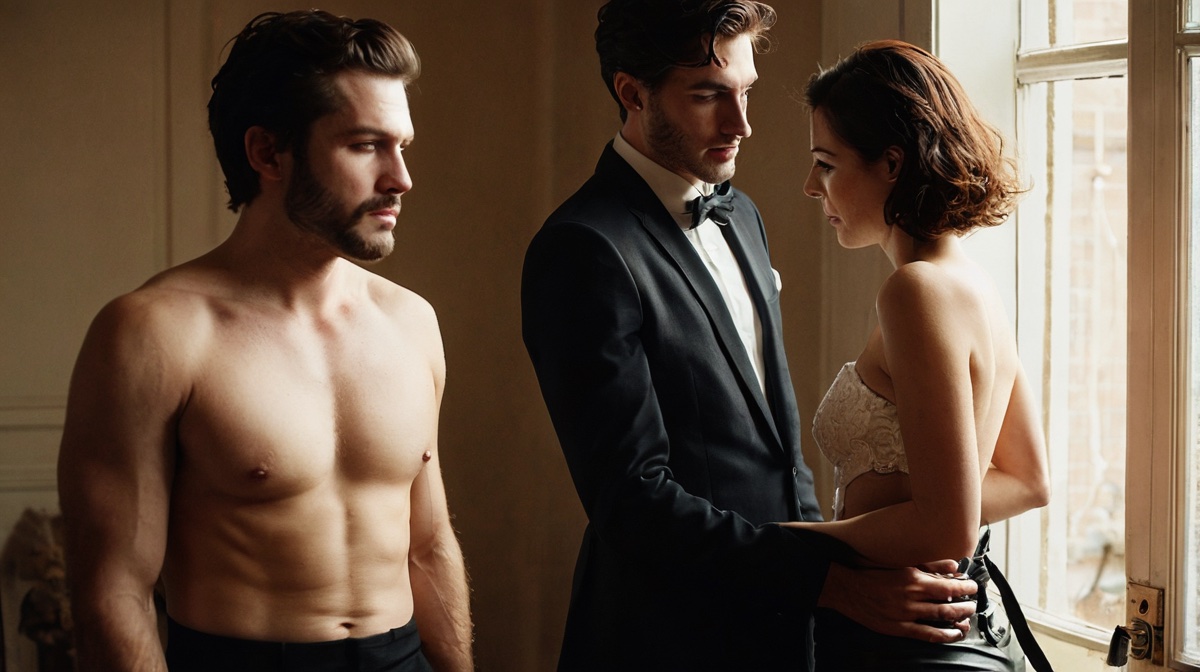
There is no former performer here, no outside voice on labour conditions, no lawyer, no clinician, nobody from a competing company, nobody who thinks the operation could be run better. The film’s central claim, that the work is consensual and carefully managed, is made in full by people who need it to be believed.
Nathan Rabin reviewed the film warmly for The Dissolve and still put the problem plainly, writing that it “sometimes feels like a promotional film not just for the website it empathetically chronicles, but also for the sex-positive ethos it embodies.” He also located the missing question with some precision: this, he wrote, “is not the kind of movie to ask whether the young man in question will regret that decision 10 years down the line.”
In Video Librarian, Frank Swietek was cooler, at two and a half stars, and named the thing that makes the film wearing: “The major drawback here is repetitiveness, as the same points are continually being made.” The point being made, over and over, is that everything on screen is safe, sane and consensual.
The reassurance crowds out the people
That repetition is the failure mode this whole shelf keeps running into. Once a documentary decides its job is to correct a prejudice, every sequence has to carry the correction. The correction then displaces everything more particular: why this person rather than that one, what they actually get out of it, what it costs them, what they think about on the drive home. The people in front of Voros are articulate and specific, and the film keeps interrupting them to vouch for them.
Here the problem has a commercial edge the other films on this shelf do not have. Kink.com sold the assurance as part of the product. Its whole market position rested on being the operation that did this properly, and a documentary that adopts the assurance as its organising principle has adopted a piece of the marketing along with it. That is not an accusation of bad faith against Voros. It is a description of what happens when the only available account of an institution comes from inside it.
What it is still good for
The film remains the most detailed footage in general circulation of how this material gets made, and the process it records is more careful and more bureaucratic than most people arguing about the subject assume. Anyone who wants to talk about screen depictions of dominance should watch the machinery once, because the machinery turns out to be call sheets and consent forms and a lot of standing around.
It is worth setting against the fiction on this shelf. The Duke of Burgundy invents a couple’s private paperwork and then films the exhaustion of maintaining it, which is a kind of honesty no documentary made with a company’s permission can reach. And the same reassurance structure, without any commercial motive at all, runs through tOuch Kink a decade later, which suggests the problem belongs to the genre rather than to this one production.
Questions viewers ask
Who directed the 2013 documentary Kink?
Christina Voros directed it and also served as its cinematographer. James Franco produced. The two had worked together before, with Voros shooting features that Franco directed, and the confusion over the credit is common because Franco was the name attached to the publicity. The film premiered at Sundance in January 2013 and then reached audiences in stages over the following two years, which is why some listings date it 2014 or 2015.
Is Kink a fair portrait of the company?
It is an accurate record of what the company was willing to show, which is a narrower thing. Voros filmed on Kink.com premises with Kink.com cooperation, and every person who speaks is an owner, a director, a crew member or a performer currently working there. Nobody who left the company unhappy appears. The film reports the assurances it was given and has no mechanism for auditing them.
What does the film actually show?
Mostly process. Casting conversations, pre-scene interviews in which performers state what they will and will not do, the mechanics of rigging and lighting, and the check-ins that follow a shoot. The camera spends more time on the crew watching monitors than on the material being produced. That procedural emphasis is the most valuable footage in it and the reason it still gets cited.
Somebody had to work this out before it was filmed
Directors get months of rehearsal and a crew. Everyone else has a conversation and an evening.
See where it happens now