Feature film
Belle de Jour: fantasy filmed exactly like fact
By Imogen Strand, Art critic Published 12 August 2026 Updated 12 August 2026
- Work
- Belle de Jour
- Director
- Luis Buñuel
- Year
- 1967
- Kind
- Feature film
The core of any Belle de Jour analysis is a formal decision rather than a plot point. Luis Buñuel films the imagined episodes and the ordinary ones in the same flat, unhurried register, with no dissolve, no music cue and no change of light to mark the border. Because nothing in the grammar tells you where fantasy begins, the film makes desire and event equally real, and the ending remains genuinely unresolved.
Luis Buñuel was in his late sixties when he made Belle de Jour, with four decades of surrealism behind him. He had opened his career with Un Chien Andalou in 1929 and L’Age d’Or in 1930, films built to be unassimilable. By 1967 he had found something more disturbing than shock, which was calm.
The source is a 1928 novel by Joseph Kessel. Catherine Deneuve plays Séverine, a young bourgeois wife in Paris who begins spending her afternoons working in a discreet house while her husband is at the hospital. Michel Piccoli plays the family friend who circles the situation with an air of amusement. That summary makes the film sound like a scandal. It plays like a study of weather.
The imagined and the actual, shot the same way
The film opens inside a fantasy. A carriage moves through an autumn wood, an instruction is given, and a punishment is carried out, before a cut returns us to a Paris bedroom and reveals the whole thing as something Séverine was picturing.
Having established the device, Buñuel then declines to use it consistently. Later episodes arrive without any framing at all. There is no ripple, no shift in the grade, no music telling you to relax because none of this counts. Fantasy and event are given identical camerawork, identical lighting and identical pace, and the viewer is left to sort them out without help.
The effect is not confusion. It is a claim about how desire actually sits in a life. Séverine’s imagined scenes are not an escape hatch from her real ones; they are the same fabric, occupying the same afternoons, filmed with the same indifference. Buñuel does not treat the interior life as a lower order of reality, which is exactly what most films do when they signal a dream with a soft edge.
The surface is couture, and the couture is the argument
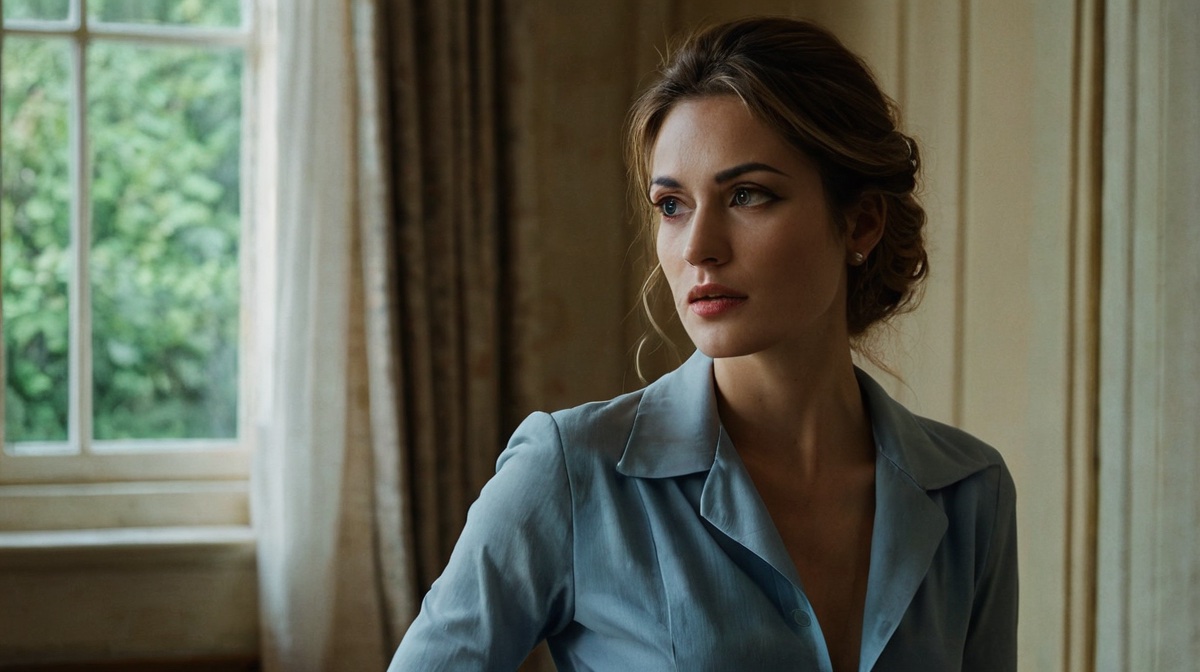
Deneuve’s wardrobe was designed by Yves Saint Laurent, and this is not a footnote. The clothes are immaculate, restrained and expensive, and they never crease. She is buttoned, gloved and coated in almost every exterior scene.
That surface performs the film’s central contrast without a line of dialogue. The more perfectly the exterior is maintained, the more visible the pressure behind it becomes. A less confident film would have loosened her hair as she loosened her life. Buñuel keeps the tailoring immaculate to the last frame, so the change has nowhere to show except in the face, and Deneuve plays it almost entirely with stillness.
There is a lesson in that for anyone reading images of power. The costume in these pictures is rarely just costume. Run the passes in how to read a picture of power over any scene here and the answer keeps coming back to clothing, posture and who is permitted to appear composed.
Refusal as a method
The famous box belongs to this same discipline. A client produces a small container, opens it for Séverine alone, and the film gives us a sound and her reaction. We never see inside. Buñuel never explained it, and the absence has generated more writing than most films manage with their entire plots.
This is refusal used as a tool rather than as coyness. By declining to show, the film puts the viewer in the position of someone who can see that another person wants something and cannot know what. That is the position most of us occupy in relation to other people’s desires, and it is uncomfortable in a way that showing the contents could never be. The opposite experiment exists and it settles the point: Beyond Vanilla opens sixty boxes in ninety minutes, demonstrating practice after practice, and comes away knowing no more about why anybody wants any of it than Buñuel tells you about the contents of his.
What later filmmakers took from it
Belle de Jour is the point at which this subject became available to serious cinema, and its influence runs through everything after it. The tone of respectability under strain, the refusal to pathologise, the flat camera, the withheld explanation: all of it is standard equipment now.
Compare it with what followed. Story of O took the same period’s appetite and answered it with decor and soft focus, losing the interiority that made its source novel work. The Night Porter took the ambiguity and attached it to history, with results still argued about half a century later. Buñuel’s contribution was narrower and more durable: he showed that you can film a fantasy without conceding that it is less real than the room it happens in, and that the older iconography traced in restraint in the western canon survives perfectly well in a Paris apartment with good curtains.
Questions viewers ask
What happens at the end of Belle de Jour?
The film provides an ending and then quietly withdraws its authority. What appears in the closing minutes contradicts what appeared shortly before, and the film offers no signal telling you which version to keep. Since it has spent two hours refusing to distinguish imagined scenes from real ones, that final ambiguity is consistent rather than a trick. Critics have argued about it since 1967 and the argument has not concluded.
What is in the box?
A client shows the contents of a small box to Séverine, we hear a faint sound from it, and we see her reaction. The contents are never shown and never named. Buñuel offered no explanation. The withholding is the point: the film hands you the fact of another person wanting something and denies you any access to what it is, which is a fair description of the whole picture.
Is Belle de Jour explicit?
No, and that surprises viewers who arrive expecting the film its reputation promises. Almost everything is elided. A door closes, a scene ends, a cut lands somewhere later. The film is far more interested in a face at a window, a pair of gloves being removed and the flatness of an afternoon than in showing anything, and that restraint is one reason it has aged better than the films that followed it.
Somebody had to work this out before it was filmed
Directors get months of rehearsal and a crew. Everyone else has a conversation and an evening.
See where it happens now