How to look
How to read a picture of power
By Imogen Strand, Art critic Published 26 July 2026 Updated 26 July 2026
Read a picture of power in five passes. Find the light source and see whose body it favours. Find who occupies the higher plane. Follow the eyelines and see who is permitted to look. Test whether the restrained figure has been granted any compositional authority. Then ask where the frame puts you, because every picture assigns the viewer a position whether it admits to it or not.
Most writing about images of dominance and submission argues about whether they should exist. That argument produces very little, and it can be conducted without looking at a single picture. The alternative is duller and far more useful: a repeatable way of describing what an individual image is actually doing.
What follows is five passes over the same picture. Each one takes a minute. Together they will tell you more than an hour of opinion.
First pass: follow the light
Light is the least deniable thing in a picture and the most decisive. Find the source, then see whose body it favours.
In a great many images of restraint, the bound figure is the brightest object in the frame while the figure with authority stands in shadow or partly outside the light. That arrangement seems to invert the power relation, and in one sense it does: light confers presence, and the illuminated body is the one the picture is about. But it also does something less flattering. A lit body is an available body, laid out for inspection, while the shadowed figure keeps the privacy of not being fully seen.
So ask two questions rather than one. Who is lit, and who is spared the light? A picture that puts both parties in the same illumination is making a different claim from one that spotlights a single figure against darkness. Neither is automatically better. They are simply different arguments.
Second pass: find the higher plane
Height is the oldest hierarchy in image making, and it is remarkably persistent. Enthroned figures sit above kneeling ones. Standing bodies read as free, seated ones as settled, kneeling and lying ones as given over.
The pass is quick. Draw an imaginary horizontal line through the picture and see who is above it. Then check the horizon line, if there is one, because the horizon tells you where the artist put the viewer’s eye. A low horizon makes the standing figure monumental. A high one looks down on everyone, including the dominant party, and can flatten a hierarchy the pose was trying to assert.
Watch for pictures that break the rule deliberately. A composition that places the kneeling figure at the exact optical centre, or that crops the standing figure at the shoulders so their head never enters the frame, has decided the hierarchy of pose is not the hierarchy of the image.
Third pass: track the eyelines
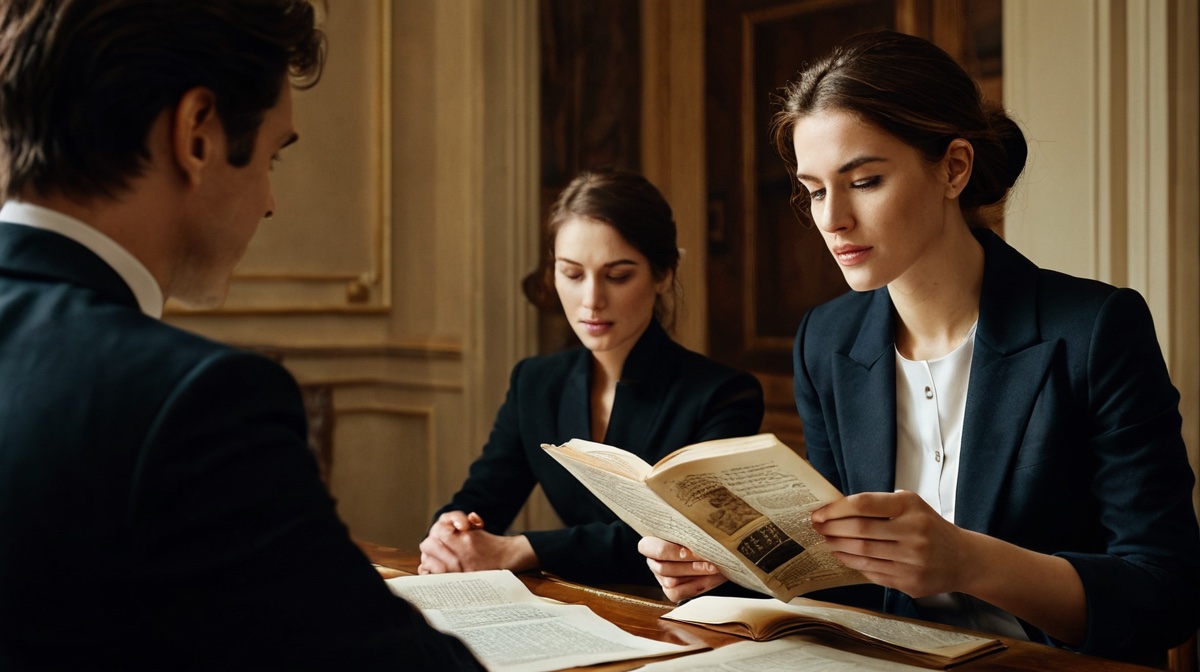
Now follow the looking. Draw every sightline in the picture: who looks at whom, who looks out, who looks at nothing.
Looking is permission. In older pictures the rule holds with dispiriting consistency: the powerful look, and the restrained are looked at. Averted eyes, closed eyes, a blindfold, a face turned into shadow, all of these remove a figure’s capacity to look back and make them purely available.
The exceptions matter enormously. A bound figure who meets the viewer’s gaze changes the transaction entirely, because it establishes that they know they are being seen and have decided to permit it. That single adjustment can turn an image of an object into an image of a participant. Watch also for the third looker, the figure inside the picture who watches the scene on your behalf. Their presence tells you the artist has thought about spectatorship, and it usually means you are being asked to notice your own.
Fourth pass: test the bound figure for authority
Pose and composition are separate languages, and they often disagree. This pass asks what the composition grants to the figure who has been physically constrained.
Run through the credits a picture can award. How much of the frame does that figure occupy? Are they at the centre, on a strong diagonal, or pushed into a corner? Does the composition converge on them or drift past them? Is the face given full attention, or cropped, masked, turned away? Is the body described with care, individual and specific, or generalised into a type?
Add them up. A figure who holds the centre, commands the light, is described precisely, and is granted an outward look has been given real compositional authority no matter what the rope is doing. A figure who is small, edge-placed, faceless and generically drawn has been given none, and the pose is not what took it away.
Fifth pass: ask where the frame puts you
Every picture assigns the viewer a position. The final pass is to work out what position you have been handed.
Start with the camera or the easel. Are you at eye level with the scene, above it, below it? Are you close enough to be present, or held back at the distance of an observer? Is anything in the composition acknowledging you: a returned gaze, a doorway, a mirror, a body turned outward?
Then ask the harder version. Does the image treat your presence as innocent? A composition that clears every obstruction and arranges the scene for an unimpeded view has decided you are entitled to be there and has taken care not to raise the question. A composition that blocks part of the view, or lets a figure look back, or puts a threshold between you and the scene, has made your looking part of its subject.
Using the five passes
Do them in order, write one sentence for each, and read the five sentences back. The description you end up with will be specific, arguable and grounded in what is on the surface, which is more than most criticism of this material manages.
The method is also a fair test of new work. The studies in the gallery each come with a note explaining what the composition is attempting, and those notes were written to be checked against exactly these five passes. For the historical conventions the method was built on, see restraint in the western canon. It travels to moving pictures with almost no adjustment, and the survey of what the kink documentaries are defending uses the first and fourth passes to catch a film whose interviews and whose images make opposite claims about the same room. The rest of the essays apply the same approach to particular pictures and particular periods.
Questions readers ask
Do I need art history training to read a picture this way?
No. Every question in this method is about things visible on the surface: light, height, direction of gaze, how much of the frame a figure holds, and where the picture places you. Historical knowledge tells you what a convention meant to its first audience, which is useful later. The five passes work on a painting from 1580 and on a photograph made last week.
Does a submissive pose always mean the figure has no power in the image?
Far from it. Composition can override pose completely. A kneeling figure lit as the brightest object in the frame, holding the centre, with every other eyeline bent towards them, is the governing presence in that picture no matter what their body is doing. The gap between what a pose says and what a composition says is often where the interesting reading lives.
How do I tell the difference between a picture about power and a picture that is simply using it?
Ask whether the image gives you anywhere to stand other than consumption. Pictures that are thinking about power tend to complicate your position: a returned look, a withheld face, a mirror, a framing that makes your presence conspicuous. Pictures that are only using power tend to smooth the way, arranging everything for an unobstructed view and asking nothing of you.
The conventions did not stay in the museum
Everything described here began with people working out what to do and what to let be seen. That negotiation is still going on somewhere other than a gallery wall.
See where it happens now