Feature film
Story of O: what the adaptation could not carry
By Rasmus Øyen, Photography writer Published 4 August 2026 Updated 4 August 2026
- Work
- Story of O
- Director
- Just Jaeckin
- Year
- 1975
- Kind
- Feature film
The Story of O film fails at the one thing its source does best. The 1954 novel is written from inside a single consciousness, and its whole force comes from a narrating mind describing its own submission with unnerving precision. Just Jaeckin adapted it as a sequence of beautifully appointed tableaux, and once the interior voice is gone what remains is a series of arrangements: chateau, costume, decor, soft light, and no way in.
The novel arrived in Paris in 1954 with a preface by Jean Paulhan and a pseudonym on the cover, and it has not stopped causing arguments since. The film arrived twenty-one years later, directed by Just Jaeckin, and settled almost immediately into a different category: a well-dressed softcore picture that people cite far more often than they defend.
Corinne Cléry plays O, a fashion photographer taken by her lover to a chateau at Roissy where she is trained, and then handed on. Udo Kier plays the lover. The outline is the novel’s outline, and the film keeps the objects that made the book famous: the collar, the ring, the country house, the uniform of consent.
The novel is a voice, and a film has no voice
Everything that is disturbing about the book happens in the grammar. The narration is measured, articulate and almost administrative, describing extremity in the tone of somebody filing a report, and the gap between the register and the content is what produces the effect. The reader is not watching a woman being trained. The reader is inside a mind that has decided to describe its own dismantling with total composure.
That is a literary effect and it does not survive translation to pictures. A camera can show a room, a face and a gesture. It cannot show the sentence a person is composing about themselves while it happens. Jaeckin does not attempt a substitute, so the film becomes a record of events that the novel treated as almost incidental.
Consider the difference this makes to the central question. In the book, whether O is free is a question the prose keeps forcing on you, because you can hear her reasoning and cannot decide if you are hearing conviction or damage. In the film she is looked at, and the question quietly disappears. She becomes the object of the shot rather than the author of the account.
The Emmanuelle house style, applied to the wrong material
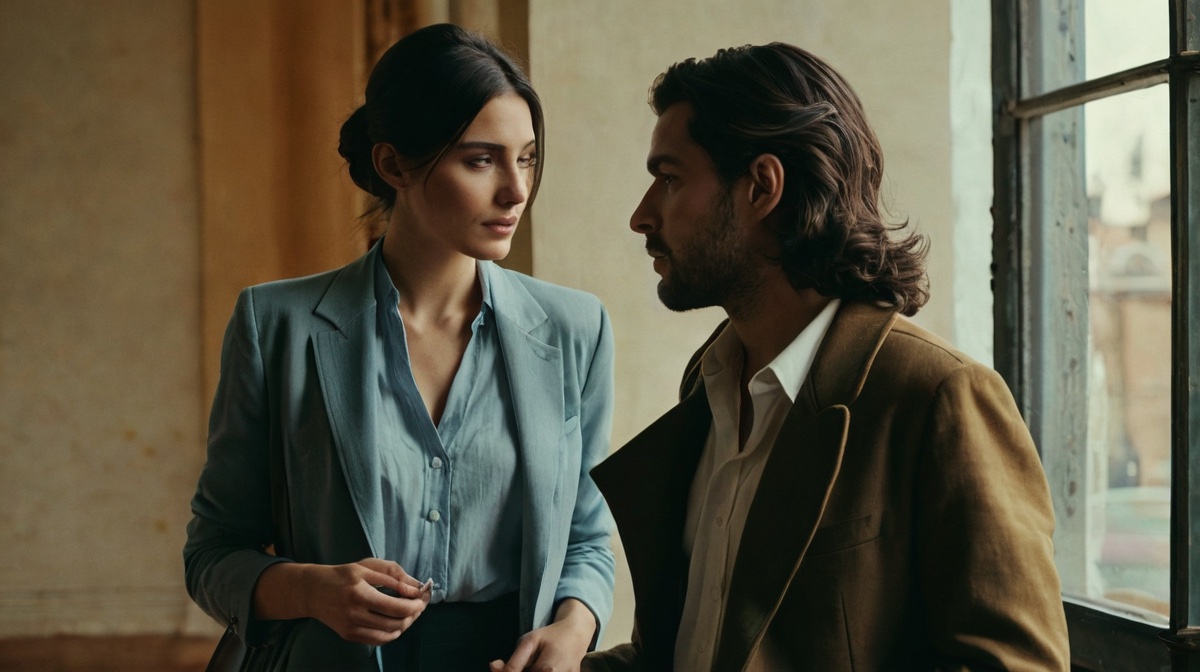
Jaeckin had made Emmanuelle in 1974, an enormous commercial success and the template for a decade of upmarket European erotic cinema. Story of O inherits that grammar wholesale: gauzy focus, warm interiors, tasteful compositions, everything lit for comfort.
Applied to this story, comfort is a mistake. The novel is austere. Its chateau is a place of rules, cold corridors and deliberate boredom, and the discomfort is the substance. The film gives it beautiful furniture and good light, and the effect is to make a text about the systematic removal of a self look like an advertisement for a country hotel.
Composition tells the same story. There is very little in the film that would repay the passes set out in how to read a picture of power, because the pictures are not arguing anything. The light favours whoever is being displayed, the framing clears every obstruction, and the viewer is granted an untroubled position throughout. Compare Belle de Jour, made eight years earlier, where the camera is flat and unhelpful and you are never quite allowed to relax.
The authorship question the film ignores
The most interesting fact about Story of O is not in the film at all. For forty years the novel was read without knowing who wrote it, and in 1994 Anne Desclos, an editor and translator who also published under the name Dominique Aury, confirmed authorship. She wrote it, by her own account, addressed to a particular reader.
That reframing does more to the material than any adaptation could. A novel of submission written by a woman for one man to read is a different object from an anonymous exercise in erotica, and the ambiguity that made the book durable is inseparable from it. The film, made two decades before the revelation, could not have used the fact. What is notable is that it shows no interest in the question either, treating the story as a given rather than as a document composed by somebody with a purpose.
Why it still matters
Two reasons, neither of them artistic merit.
First, the film fixed a look. The chateau, the formal costume, the collar, the ring worn as a sign of belonging: this is where a great deal of later fashion imagery got its props, and the borrowing rarely came with any of the book’s ambivalence. The line runs directly into the studio photography discussed in the profile of Helmut Newton.
Second, the film runs straight into a problem that is not its alone. Material about interior states resists filming, and the temptation is always to shoot the furniture instead. Older painting had the same trouble and solved it with allegory. Television found a workaround unavailable to a single picture, which is to keep going until an interior state has been shown so often that it reads as a habit rather than an event, and that route is traced in kink on television. The Night Porter, released a year before this, solved it by making the interior state historical and unbearable. Jaeckin did not solve it, and few films have paid so much to show so plainly what gets lost.
Questions viewers ask
Who actually wrote the novel Story of O?
It appeared in 1954 under the name Pauline Réage, with a preface by the critic Jean Paulhan, and the identity of the author stayed hidden for forty years. In 1994 the French editor and translator Anne Desclos, who also published as Dominique Aury, confirmed that she had written it. The book had been widely assumed to be by a man. Learning that it was written by a woman, and written for a particular reader, changes how the novel reads and is a large part of why it is still discussed.
Is the film faithful to the book?
Event by event it follows a good deal of it: the chateau, the training, the collar and ring, the transfer between men, the country house. What it cannot reproduce is the narration. The novel is relentless about the inside of a mind, and the film has no equivalent device, so it stages the events and lets the surfaces speak. The result is faithful in incident and unfaithful in everything that made the incidents mean anything.
Why does the film look the way it does?
Because of who made it and when. Just Jaeckin had directed Emmanuelle the year before, and the house style of that picture carried straight over: soft focus, warm filters, expensive interiors, tasteful framing, a score that smooths everything. It is the visual language of an upmarket advertisement, applied to material that is about deprivation and control. That mismatch is the central problem with the picture, and it was noticed immediately.
Somebody had to work this out before it was filmed
Directors get months of rehearsal and a crew. Everyone else has a conversation and an evening.
See where it happens now