Feature film
The Night Porter: the most contested film on this list
By Imogen Strand, Art critic Published 22 July 2026 Updated 22 July 2026
- Work
- The Night Porter
- Director
- Liliana Cavani
- Year
- 1974
- Kind
- Feature film
The Night Porter film is the entry on this list that criticism has never settled. Liliana Cavani took a relationship formed under absolute coercion in a concentration camp and showed the two people resuming it privately in Vienna twelve years later. Serious critics have called it an unflinching study of the bond between victim and persecutor, and other serious critics have called it the aestheticising of fascism. Both positions are held by people who have watched it closely.
Every other film discussed in this section can be recommended with a straight face. This one cannot, and pretending otherwise would be dishonest. Liliana Cavani’s 1974 picture has been condemned and defended continuously for half a century, by people whose judgement is worth taking seriously in both directions. The useful thing a critical site can do is describe the dispute accurately rather than adjudicate it.
What the film is
Dirk Bogarde plays Max, once an SS officer, now the night porter of a Vienna hotel in 1957. Charlotte Rampling plays Lucia, who survived the camp where he was posted and who arrives at the hotel as a guest. They recognise each other. She does not leave.
The plot that follows is a siege. Max belongs to an informal circle of former officers who hold mock proceedings among themselves, destroying documents and disposing of anyone who could testify. Lucia is a witness. The relationship the two of them resume is conducted inside a flat while the group outside waits, and the ending is not a reprieve.
Bogarde was at the height of his late career and had already built a reputation for taking roles other leading men would not. Rampling was young and became permanently associated with this part. Neither disowned the film afterwards.
The argument against it
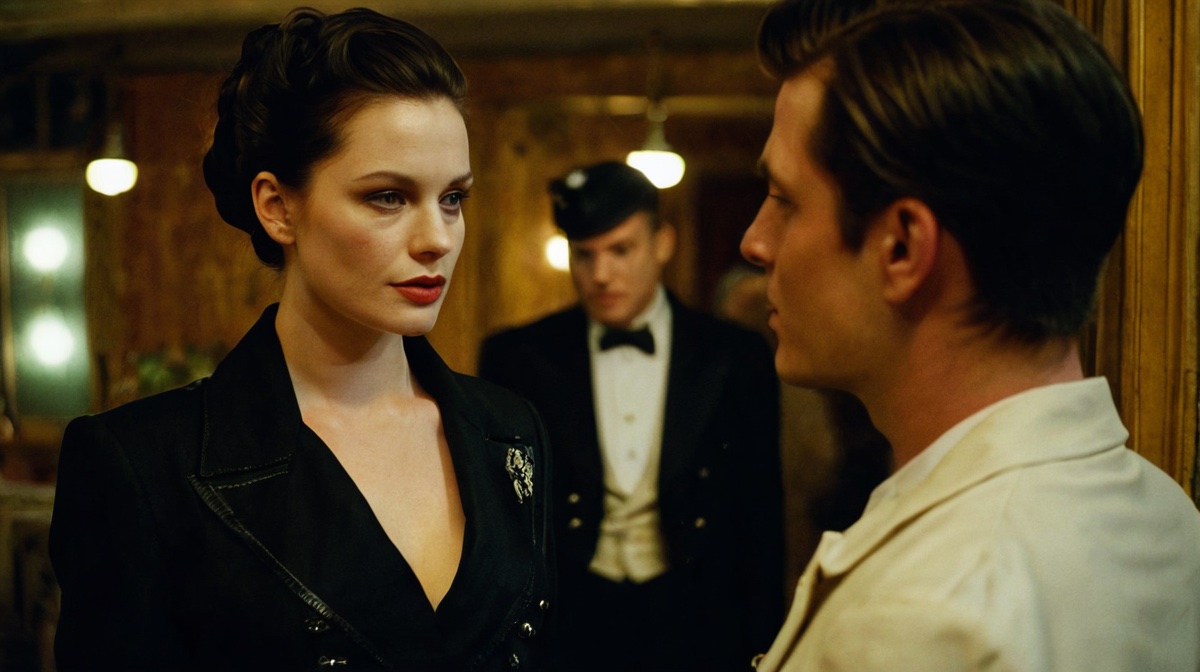
The objection is not squeamishness, and it is not the presence of the subject. It is a claim about what the film’s surface does independently of its intentions.
Cavani gives the camp scenes a controlled, composed look, and she costumes them. The most reproduced image from the film is a performance sequence in which Rampling appears in fragments of SS uniform. That image left the film almost immediately and had a second life in fashion shoots, record sleeves and pornography, in contexts with no interest whatever in the psychology of survivors. Critics argue that this was predictable, that a beautifully lit atrocity is still an atrocity that has been made beautiful, and that the film supplied a visual vocabulary the culture then used badly for decades.
Susan Sontag’s 1975 essay on the aesthetics of fascism gave this objection its most durable statement, and Cavani’s film is routinely named in the argument that followed. Reviewers at the time were often blunter. Roger Ebert dismissed it outright, and he was not alone among major critics.
The argument for it
The defence is not that the objection is silly. It is that the film has been read too quickly.
On this reading, the picture is about a bond formed under conditions that removed the possibility of consent, and about what that does to two people afterwards. Nothing in the film presents the camp as anything other than a system of terror. The relationship in 1957 is shown as a collapse, not as a romance: the pair barricade themselves in, stop eating properly, and are destroyed. Cavani has argued for decades that her subject was the psychology of the persecutor and the persecuted, and she came to the material with a serious interest in the period rather than as a provocateur.
Defenders also point out that the objection proves a great deal if it proves anything. If a film may not depict an eroticised power relation formed under coercion, a large part of what fiction does about atrocity becomes unavailable.
Where this leaves a viewer
There is no reconciliation available between those two positions, and this site is not going to manufacture one. What can be said plainly is that the film is not a study of consensual power exchange and should never be cited as one. Whatever is happening between Max and Lucia, it began in a place where refusal was impossible, and the film knows it.
That distinction matters for the rest of this section. The Duke of Burgundy is about negotiation, scheduling and consent maintained under strain. Belle de Jour is about a fantasy life that harms nobody. This film belongs to a different category, and blurring the categories is how the whole subject gets discredited. The blurring does not require anything as extreme as Cavani’s material either: Obsession, made half a century later by people who said in advance that they did not want to imply this sex was damaging, inherited a plot from 1991 in which a man’s wanting ruins his family and let the plot make the argument for them.
If you do watch it, the passes in how to read a picture of power are more useful here than anywhere else, because they force the question of who the composition serves. Ask, in each camp sequence, whether the framing is describing a horror or arranging one. Different viewers give different answers to that question, honestly, which is precisely why the argument has lasted. The broader version of the same dispute, about whether an image of dominance describes power or merely sells it, runs through the profile of Helmut Newton.
Questions viewers ask
What is The Night Porter about?
Vienna, 1957. A man working nights at a hotel is a former SS officer living quietly under a new identity, protected by a group of former colleagues who are busy erasing evidence and witnesses. A guest arrives with her husband and recognises him: she was a prisoner in the camp where he served. Rather than reporting him, she stays, and the two resume a private arrangement that began under total coercion. It ends badly for both of them.
Why is the film so controversial?
Because of what it risks by combining two things. It uses the imagery of the Nazi camps, and it films a relationship of dominance and submission. Critics who object argue that putting the two together turns historical atrocity into an erotic register, no matter what the film intends, and that the costume imagery in particular escaped into fashion and pornography almost immediately. Critics who defend it argue that the film is about damage rather than desire, that it never presents the camp as anything but a horror, and that refusing to look at how coercion warps a survivor is its own kind of evasion.
What did Cavani say about it?
She has consistently defended the film as an attempt to examine the psychology of the bond between a persecutor and the person they persecuted, and has rejected the reading that it eroticises fascism. She has maintained that position in interviews across decades. Whether what a director intends settles the question of what a film does is a separate argument, and this film is where it is usually fought out.
Somebody had to work this out before it was filmed
Directors get months of rehearsal and a crew. Everyone else has a conversation and an evening.
See where it happens now