Iconography
Kink on television
By Imogen Strand, Art critic Published 26 August 2026
Kink on television behaves differently from kink in film for one structural reason: episodic time. A series that runs for years can let a dynamic become an ordinary fact about two people, which no two-hour picture can manage. Working against that advantage, commissioning limits push the subject toward comedy or toward ruin. Billions, Bonding and Obsession are three results of that pressure, and only the first of them gets the full benefit of the duration.
Three series, made between 2016 and 2023 for two outlets. Billions ran seven seasons on Showtime and carried a submissive lead the whole way, from the opening minutes of the pilot to a finale eighty-four episodes later. Bonding managed fifteen episodes on Netflix, none longer than a quarter of an hour, and had a public argument about its accuracy attached to it within a week of release. Obsession lasted four episodes and was widely found tedious.
Two forces account for most of the difference between them. The first is duration, which is the one real advantage the medium has with this subject. The second is the commissioning environment, which pushes the material toward comedy at one end and toward ruin at the other, and rarely leaves room for anything in between. Each of these three shows is a different result of those two things pulling against each other.
What eighty-four episodes buy
Television’s default treatment of this material is the revelation episode. A character is exposed, a marriage wobbles, an hour of plot is extracted from the exposure, and the subject is retired. The structure treats a preference as information, and information can only be delivered once.
Billions declines it by running long enough that declining costs nothing. Chuck Rhoades is established as a submissive in the first minutes of the pilot, broadcast in January 2016, and nobody inside the story does anything with the knowledge until the fortieth episode. For more than three years the practice functions as characterisation: a thing the marriage contains, mentioned, resumed, negotiated around, occasionally strained, never the engine of a plot.
That is the whole manoeuvre and it is not available to film. A two-hour picture showing this once has made a statement, because a single instance inside a closed structure has to mean something. A series showing it in passing across eighty-four hours, between subpoenas, has made it a fact about two people. Duration does the normalising without anybody having to argue for it, which is why the least ambitious series here is the most useful one.
The show pays for the manoeuvre elsewhere. Its pilot buys a shock by withholding the face of the woman administering the pain, so that for one episode Chuck’s wife is a technique with no person attached to it. And when the disclosure finally arrives, in an episode named after the theory describing what public opinion will currently tolerate, Chuck goes to the podium over his wife’s clear and stated refusal. Elena Nicolaou, writing for Refinery29 the day after broadcast, read the celebrated speech as selfish rather than brave and followed the episode’s attention to Wendy’s face rather than to Chuck’s victory. A drama praised for its care about consent built its largest scene on a man overriding a refusal, in the course of disclosing a practice that exists only by agreement.
Where the length runs out
Bonding had the opposite constraint and got the argument that follows from it. Netflix commissioned short-form comedy, and the episodes run between thirteen and seventeen minutes, which is enough for a joke, a session, a reversal and a soft landing.
What will not fit inside that is a negotiation. Two people agreeing what will happen, what will not, and how it stops is slow, verbal and visually inert: structurally it is a scene of people settling terms, which is close to the least dynamic thing a camera can be pointed at. An hour of drama absorbs it. A fifteen-minute comedy has to cut it, and once it is cut the sessions look like events that happen to people rather than arrangements people made.
So the most repeated objection to the first season, that consent is largely absent from it, is partly an objection to a commissioning decision. Mistress Blunt, reviewing for Vice on 29 April 2019 as a working New York dominatrix, made that point alongside sharper ones about the lead character pushing an assistant past a refusal he had already given. ScreenRant’s accuracy breakdown overlapped with her on consent and on professional boundaries. Practitioners also caught a costume error immediately, and it is the most legible sign in the whole series: the dominatrix wears a collar, which in the scene is a submissive’s item, and nobody in the room could read the vocabulary the show was borrowing.
The format explains a good deal of that and not the part that matters most. Rightor Doyle created the series, wrote it and directed all fifteen episodes, which is unusually complete authorship for a Netflix comedy, and he built it from the assistant’s point of view. That decision settles in advance who is allowed to be a person and who is allowed to be a job. The dominatrix runs every room in the series and is the least interior character in it, and no amount of running time would have changed that. A show may choose its genre. Choosing the genre does not entitle it to present itself as a corrective to how a profession is understood, because a corrective has to be able to see the professional.
Obsession has the billing and not the shape
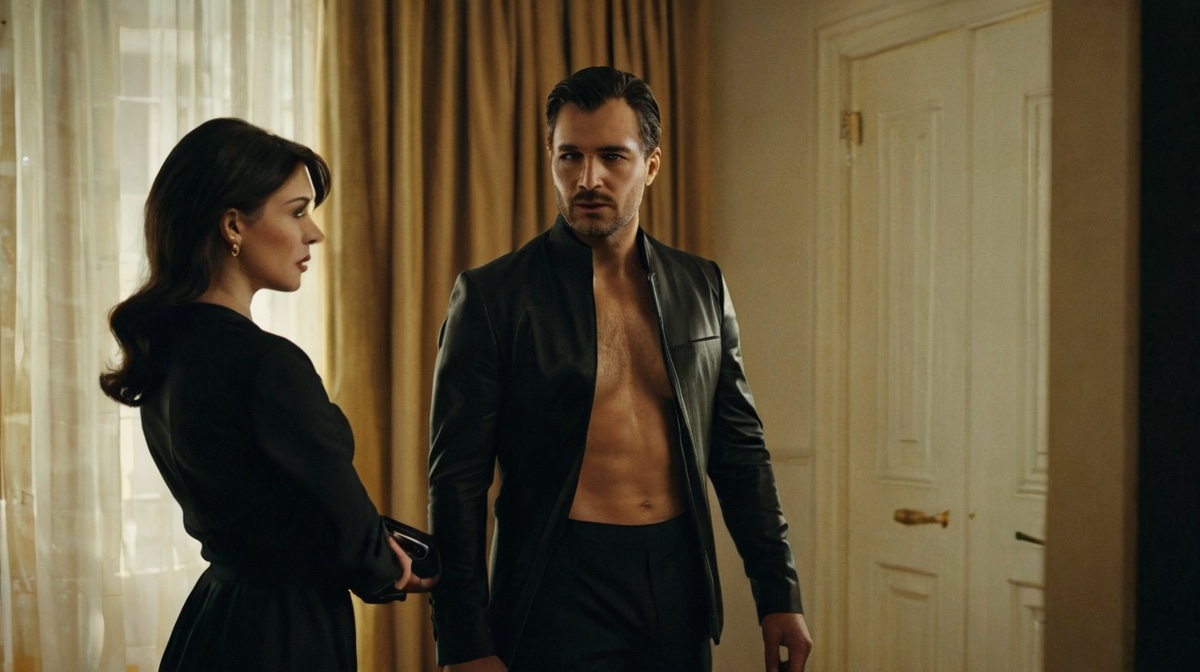
The duration argument does not apply to Obsession at all, and saying so is more useful than forcing it into the pattern.
Four episodes of thirty to forty minutes is a film’s length wearing a series’ billing, and the thing behaves accordingly. One relationship, one escalation, one collapse. No subplot running on its own clock, no scene that exists because a season had room for it. Nothing in the form gives the material time to become ordinary, and the show never looks like it wanted the time.
What arrives instead is film’s oldest habit with this subject, which is desire as catastrophe, and it arrives because the plot was built to produce it. Obsession adapts Josephine Hart’s 1991 novel Damage, filmed by Louis Malle the following year. That story is a machine for demonstrating that a respectable man’s wanting destroys his family. Attach a power dynamic to the engine and the dynamic becomes the mechanism of ruin, no matter how gently anyone films it.
Morgan Lloyd Malcolm, who wrote the series with Benji Walters, described both halves of the problem in an interview with Zoe Williams published in the Irish Times on 4 April 2023, before release. She was explicit about the intention. “It was really important to me to not be saying anything like: ‘BDSM sex is bad sex,’” she said. She was equally explicit about the constraint, saying the show had to be a vanilla version of kink because it was mainstream television, which in practice meant ribbon, restraint and blindfolds. The intention lives in the dialogue and the tone. The argument lives in the structure, and nobody had to write a line condemning anything for the ending to condemn it.
The marketing supplies a footnote worth keeping. Rolling Stone reviewed the series under a headline proposing it might be Netflix’s kinkiest to date, a framing several outlets echoed, about a programme its own writer had already described as a deliberately mild version of the subject. What counts as the far edge on a mainstream platform is set low enough that a ribbon and a blindfold can be sold as it.
A medium that can revise itself in public
One thing television can do that film cannot has nothing to do with length.
Doyle brought in Olivia Troy, a BDSM professional and intimacy coordinator, for the second season of Bonding, and Variety’s account of that season is essentially an account of a production rebuilt around advice it had not previously sought: costume corrected, session detail corrected, community members cast rather than imagined. Jess Joho, writing for Mashable, found the result markedly less interested in the leather and markedly more interested in communication and the setting of boundaries. The show also turns on its own protagonist and treats the first season’s behaviour as behaviour rather than as charm.
A film is finished when it is finished. A director who mishandles a subject can answer critics in interviews but not in the work. A renewed series answers in the work, and the answer is legible precisely because the earlier version is still sitting there to be compared with it. Nothing on this site’s feature shelf offers anything like it: Secretary has been argued over for more than twenty years and remains exactly the film it was on release.
What the second season did not revisit is the point of view. That was the objection underneath all the checkable ones, and answering it would have meant rebuilding the show around a different character, which is a great deal to ask of a renewal. Netflix cancelled the series in July 2021.
The small pool doing the work
Troy’s professional listing carries the second season of Bonding alongside Billions. Obsession worked with the intimacy coordinator Adelaide Waldrop. Set those facts beside each other and the number of people advising television on this material is visibly small, and its members were attached to the two productions on this shelf that handle it best.
Lloyd Malcolm made a related observation in passing in the same Irish Times interview: it is only now that intimacy coordinators are standard that a drama can let sex drive a plot rather than decorate one. That gap is the actual condition of the subject on television. The apparatus for filming it responsibly has improved a great deal faster than the range of things a commissioner will let anyone say with it.
Which leaves duration as the only variable that has reliably produced anything here. It was not care that made the difference, because Obsession had care, an intimacy coordinator and a writer who said in advance what she was trying to avoid. It was not authorship either, because Bonding had authorship in unusual concentration and used it to look the wrong way. Billions got there by having eighty-four hours and being willing to spend some of them on nothing in particular. The documentaries have no comparable lever, and what they reach for instead is the subject of what the kink documentaries are defending.
Questions readers ask
Which television series handle BDSM seriously?
Billions is the substantial case. Showtime ran it for seven seasons and eighty-four episodes with a submissive lead established in the opening minutes of the pilot, and it worked with a BDSM consultant rather than guessing. Bonding, on Netflix, is the argued-about case: fifteen short episodes, a public accuracy dispute, and a second season visibly rebuilt in response. Obsession, also on Netflix, is four episodes long and is included here as the counter-case rather than as a recommendation.
Why does television treat this differently from film?
Length. Film has to make a single instance mean something, so the material tends to arrive as revelation or as catastrophe. A long-running series can show the same thing in passing dozens of times until it stops being an event and becomes a fact about a character. Television also has a capacity film lacks entirely, which is the ability to revise itself between seasons in front of the audience.
Did any of these productions work with practitioners?
Yes, and the same small pool keeps appearing. The intimacy coordinator and BDSM professional Olivia Troy lists both Billions and the second season of Bonding among her credits, and Variety reported that Bonding brought her in specifically after the criticism of its first season. Obsession worked with the intimacy coordinator Adelaide Waldrop. The infrastructure for filming this material has improved a great deal faster than the range of things a production is permitted to say with it.
The conventions did not stay in the museum
Everything described here began with people working out what to do and what to let be seen. That negotiation is still going on somewhere other than a gallery wall.
See where it happens now