The canon
The odalisque, or restraint without rope
By Imogen Strand, Art critic Published 10 September 2026
The odalisque painting meaning turns on a substitution. European artists wanted a nude who could be looked at indefinitely and who had no power to leave, and the harem picture supplied one without a single rope in the frame. Confinement was handled by the setting: a room in another country, under another legal system, which the viewer was invited to observe from an impossible vantage point. The restraint is architectural rather than physical, and it is more complete than any chain, because a chain can be seen and argued with.
The bound captive of the older tradition needed an explanation. A rope in a picture raises a question, and the question has to be answered by a story: a monster demanded it, a court sentenced her, a saint refused to recant.
The nineteenth century found a way to skip the story. If the room itself cannot be left, nothing has to be tied.
The substitution
An odalisque is a woman in a harem, painted by a European who has not been in one. She reclines, usually on cushions, usually with her back or her side presented and her head turned. There is often an attendant, sometimes a musical instrument, always textiles. There is never a door.
Everything the captive tradition achieved with rope, this arrangement achieves with architecture and law. The viewer understands that she is somewhere she cannot walk out of, and understands it without any visible restraint, which means the picture never has to acknowledge that restraint is its subject. Compare it with the conventions catalogued in restraint in the Western canon and the family resemblance is exact. Only the alibi has been upgraded. Myth explained Andromeda’s chain. Ethnography explained the odalisque’s room, and ethnography had the advantage of sounding like information.
Jean-Auguste-Dominique Ingres painted the Grande Odalisque in 1814, commissioned by Caroline Murat, Queen of Naples and Napoleon’s sister. It reached the Salon in 1819, where critics complained about the anatomy: the figure was said to have two or three vertebrae too many. Later analysis puts the elongation closer to five, along with a rotation of the pelvis that no living spine will produce.
That criticism was correct and it missed the point. The body was altered because the line required it. A back that long produces a contour that unrolls across the canvas without interruption, and Ingres wanted the contour more than he wanted the skeleton. It is worth naming what that decision is. A body edited into a better shape has been overruled by the person painting it, which is the same relation the picture depicts, executed at the level of draughtsmanship.
The distance was the whole device
Set the scene in France and it becomes a question. Set it in an unnamed Ottoman interior and it becomes a report.
This is what Linda Nochlin identified in an essay published in Art in America in 1983 and reprinted in her collection six years later. The Orientalist picture presents itself as documentary while containing no evidence of a documentarian. Nobody in the room is aware of being observed, no European appears in the frame, and the viewer is granted a vantage point that could not exist. The absence of the observer is not an oversight. It is the mechanism that makes the looking feel like knowledge rather than intrusion.
Eugène Delacroix had at least been to North Africa, travelling with a French mission in 1832, and Women of Algiers in their Apartment followed in 1834. Most of the others had not, and it made remarkably little difference to the pictures, which is itself the strongest evidence that the genre was never about the place.
Jean-Léon Gérôme took the logic to its conclusion with The Slave Market in 1866, now at the Clark Art Institute. A woman stands stripped in an open square while a buyer examines her teeth. The picture is presented as an appalled record of a practice elsewhere, and it is composed so that the Salon visitor occupies the position of the man doing the examining. Gérôme’s The Snake Charmer, from around 1879, ended up on the cover of Edward Said’s Orientalism in 1978 and became the standing illustration of the argument, although Said never discusses it in the text.
What the composition grants her, and what it withholds
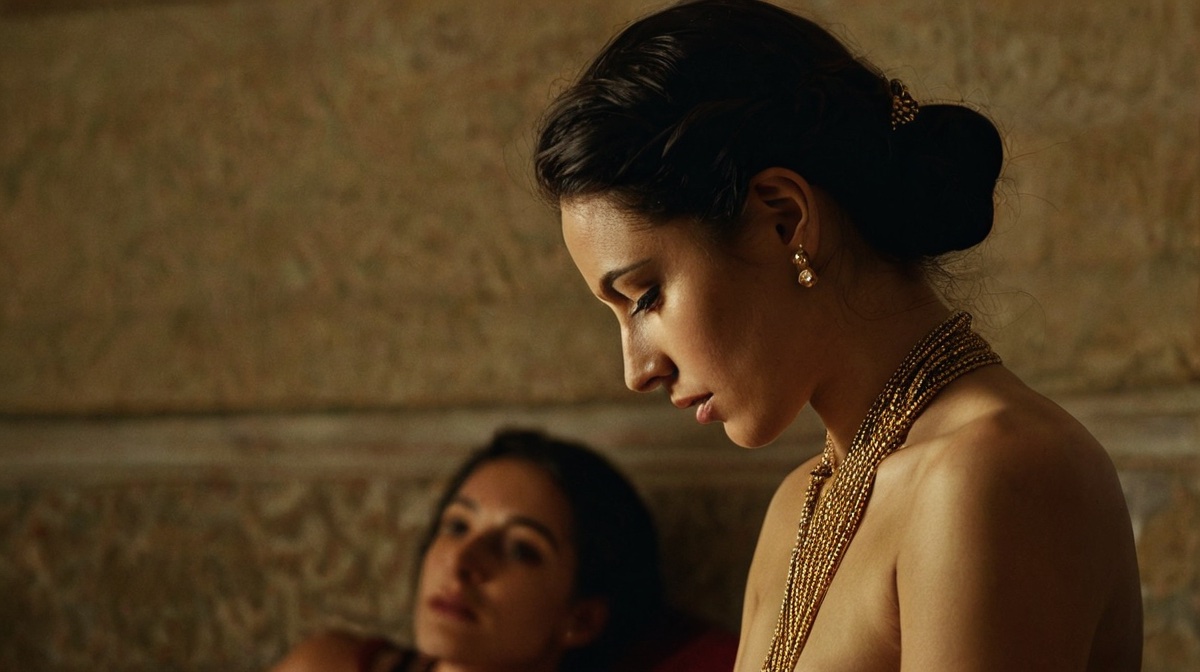
Run the fourth pass over a good odalisque and the result is strange.
She is lit, and lit generously. She holds the centre, or the long diagonal, which comes to the same thing. She is described with more care than anything else in the frame, often more care than the artist gave to any portrait of a paying sitter. By the usual measures she has been granted every compositional credit available.
One is missing, and it is the one that would change the picture. She is almost never permitted to know where she is. The face is turned, or the eyes are unfocused, or the expression is set to a pleasant blankness that indicates no relation to the room, the attendant or the viewer. She has been given beauty, presence and scale, and denied awareness, and awareness is the only credit that would make the rest of them hers.
Ingres returned to the theme in Odalisque with Slave in 1839, now in the Harvard Art Museums, with a second version made in 1842 that is at the Walters Art Museum in Baltimore. Harvard now catalogues its version under a title that names the other two figures as an enslaved woman and a eunuch rather than folding them into the decor, which is a small institutional correction and a telling one. The picture had been describing three unfree people for a hundred and eighty years while the title admitted to one.
Manet moved it to Paris
Olympia was painted in 1863 and shown at the Salon in 1865, and it is the same picture with the alibi removed.
The pose is the tradition’s own: reclining, nude, an attendant behind her, textiles everywhere. What Manet changed was jurisdiction. She is in a Paris bedroom. She has a name, and the name belongs to a working woman rather than a goddess. Her hand is placed with intent rather than modesty. She wears a black ribbon at the throat, one of the most efficient pieces of signalling in nineteenth century painting, and a detail worth reading alongside everything else the band at the neck has meant in the collar in painting. Above all she looks out, directly, at whoever has come to stand in front of her.
The Salon’s reaction is usually described as shock at the nudity, which cannot be right, because the Salon of that decade was full of nudes and gave prizes to several. The shock was structural. Once the scene is local, contemporary and aware of you, the viewer stops being an observer of a distant custom and becomes the person who has just walked in. Every odalisque had been offering the same position. Olympia was the first to say so out loud.
Afterwards
The convention did not end; it relaxed into candour. Henri Matisse spent much of the 1920s in Nice painting odalisques with hired models, studio screens and rented textiles, and made no serious pretence that the room was anywhere but his own. What had been an ethnographic claim became an acknowledged studio arrangement, which is a form of honesty even when the pictures are otherwise unchanged.
The Grande Odalisque itself came back into the argument in 1989, when the Guerrilla Girls put it on a poster wearing a gorilla mask, under a question about how many women in the Metropolitan Museum’s modern galleries were artists and how many were nudes. Using that particular figure was exact. She is the most completely composed body in the tradition and the least consulted, and the mask worked because it gave her the one thing two centuries of admirers had not: a face doing something on purpose.
That is the reading test the genre keeps failing, and it is the same test that separates the two halves of the Judith tradition. A picture can hand a woman the light, the centre and the finest drawing in the room, and still be withholding the only thing that would make the picture hers.
Questions readers ask
What does the word odalisque actually mean?
It comes from a Turkish term for a chambermaid or attendant, and by the time French painters were using it the sense had drifted to something closer to concubine. The drift is the interesting part. The word arrived describing a job and left describing an availability, which is a fair summary of what the pictures did to the subject as well.
Is the odalisque a form of bondage imagery?
It is the same appetite solved a different way. The tradition of the bound captive needed a rope and a story to explain it. The harem picture needed neither, because the setting was understood to do the holding. A woman who cannot leave the room does not have to be tied to anything, and the composition can then spend all of its attention on her body without ever showing the mechanism.
Why was Manet's Olympia such a scandal when odalisques were not?
Because he removed the geography. Olympia holds a pose the Salon had accepted for decades, with the same reclining body and the same attendant, but she is in Paris, she has a name, and she looks straight out at the visitor. Once the scene stops happening somewhere else to somebody else, the arrangement becomes a transaction the viewer is part of. The nudity was never the problem. The address was.
The conventions did not stay in the museum
Everything described here began with people working out what to do and what to let be seen. That negotiation is still going on somewhere other than a gallery wall.
See where it happens now