The canon
Judith and Holofernes: the reversal the canon kept painting
By Imogen Strand, Art critic Published 3 September 2026
The Judith and Holofernes meaning changes with almost every painter who takes it up, because the story hands the artist a decision that cannot be avoided. A woman has a general at her mercy in his own tent, and the composition must say whether she is a heroine, a monster or an ornament. Medieval Europe filed her under a warning genre about men undone by women. Caravaggio made her flinch. Artemisia Gentileschi made her competent. Klimt turned the whole thing into a portrait of appetite and put a gold band around her throat.
There is one subject in European art where the pose does the whole job for once. A man lies helpless. A woman stands over him with a blade. Nothing in the composition needs to be argued into place, because the story has already put her on top.
Painters went back to it for five hundred years, and what they did with it says more about each of them than almost any other commission would.
The warning genre she arrived in
Judith did not enter Western art alone. She came in as one item on a list.
Medieval and Renaissance Europe had a recognised topos, known in Germany as Weibermacht and in English as the Power of Women, showing wise or heroic men brought down by women. Phyllis rides Aristotle like a horse. Delilah takes Samson’s hair. Jael drives a tent peg through Sisera’s skull. Salome collects a head on a dish. Solomon is led into idolatry, and Virgil is left dangling in a basket. The set was popular in Germany and the Low Countries, and it attracted the best printmakers available, Dürer and Cranach the Elder and Lucas van Leyden among them.
The genre works as a joke with a moral inside it. Look what happens when the hierarchy inverts, it says, and the looking is licensed by the warning. This is precisely the alibi structure catalogued in restraint in the Western canon, running in the opposite direction. A martyrdom licensed a lingering look at a bound body by calling it devotion. Weibermacht licensed a lingering look at a dominant woman by calling it a caution.
The trouble with Judith is that she does not fit. Delilah betrays. Salome is a child doing her mother’s errand. Judith saves a town, prays before she goes, and returns home to a long and respectable life. The text makes her a heroine. The pictorial tradition spent centuries trying to file her somewhere else.
Donatello made her a civic monument
Donatello cast his bronze group between 1457 and 1464 for the Medici, and it is not an erotic object at all. Judith stands, fully clothed and vertical, sword raised, with Holofernes slumped between her knees. The composition is a column with a decision on top of it.
Its later history is the point. After the Medici were expelled from Florence the group was moved in 1495 to stand beside the entrance of the Palazzo Vecchio, where it functioned as a public warning to tyrants. It has been moved repeatedly since and now stands inside the palace with a replica outdoors. A picture of a woman killing a man had become the city’s emblem of legitimate resistance, which tells you the subject was never confined to the bedroom.
Caravaggio made her flinch
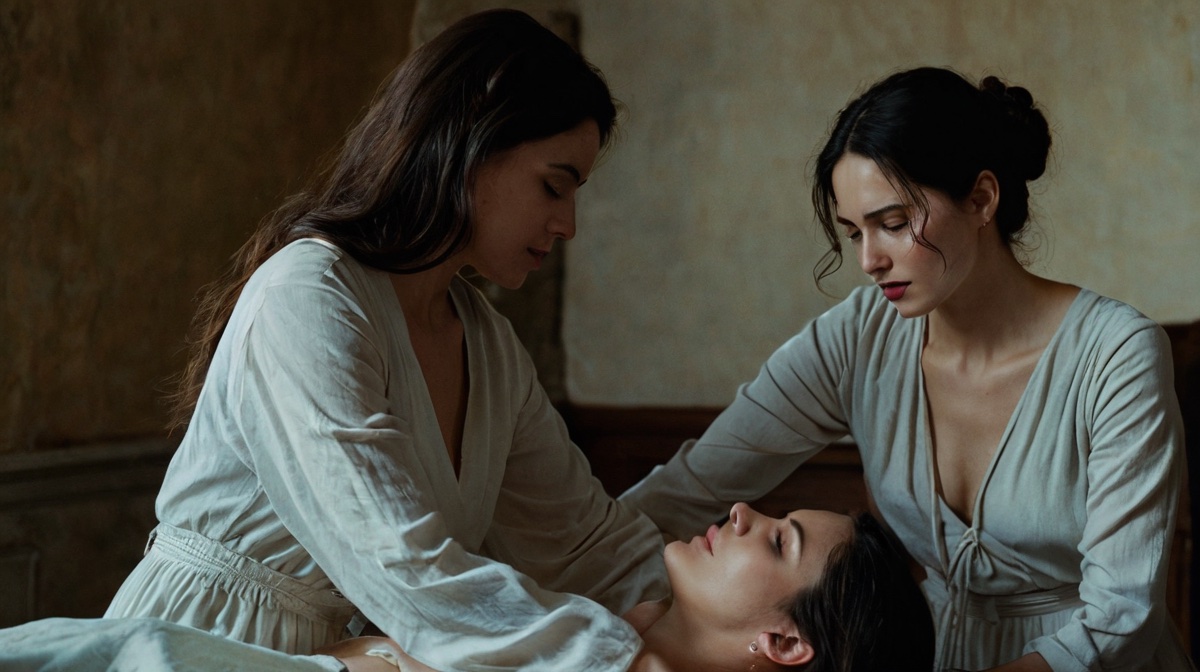
The version now in the Palazzo Barberini in Rome, painted around 1599, is the most influential and the strangest.
Caravaggio picks the exact instant of the cut, which nobody had done with that directness. Then he undoes it. His Judith is at full arm’s length, leaning away from the work, her brow drawn into an expression somewhere between distaste and concentration. She looks like a young woman doing something unpleasant to a fish. Beside her an old servant waits with the bag and watches with complete equanimity.
The composition preserves her by making her incompetent. She is close enough to kill and far enough away to remain a girl, and the arms are extended at a length that would give her almost no purchase. Everything violent in the picture is happening to Holofernes, and almost nothing is happening in her.
Artemisia Gentileschi made her competent
Artemisia Gentileschi’s version in Naples, painted around 1612 to 1613, is the correction, and it corrects at the level of physics.
Her Judith is close in, braced, with sleeves pushed back and the weight of her upper body committed to the blade. The maidservant is not standing by with a bag; she is on the bed with both hands holding the man down while he fights. Two women are doing a job that needs two, and the arms of all three figures wheel around the wound at the centre of the canvas so that every line in the picture converges on the point where force is being applied.
This is a painting about leverage. It knows that a beheading is heavy work and that a person doing heavy work leans in. Gentileschi painted a second version, now in the Uffizi, between 1613 and 1621.
The biography is documented and needs stating carefully. The Naples picture dates from around the time of the 1612 trial of Agostino Tassi, who had raped her, and the art historian Mary Garrard read the painting as an expression of the artist’s rage. Later scholarship has moved away from binding the two so tightly, pointing out that capable women at the centre of the action are the constant of her whole career rather than a response to one event. Both things can be held at once: the trial is a fact, the reading is an interpretation, and the picture is strongest as evidence of what its painter understood about applied force.
Cranach and Klimt made her an ornament
The other solution is to remove the act entirely and keep the woman.
Lucas Cranach the Elder and his workshop produced the composition repeatedly, and the version of about 1530 in the Metropolitan Museum is typical. Judith stands in the court dress and jewellery of Cranach’s own Saxony, composed, cool, faintly amused, with the head set beside her like a purchase. The contrast between her serenity and the object on the table is the entire effect, and it converts a siege into a mood.
Gustav Klimt finished the sequence in 1901. Judith I, in the Belvedere in Vienna, is a small vertical panel, and the head of Holofernes has been pushed almost out of the bottom corner where a careless viewer will miss it. What is left is a woman with half-closed eyes and gold leaf everywhere, in a painting that marks the start of Klimt’s golden period. Around her throat is a wide gold collar studded with stones.
Look at what that decision does. The one figure in Western art who is defined by having taken a head is given a band at the neck, at the exact place where a head is taken. The picture puts a claim on her in the same gesture that celebrates her, which is why it belongs in any account of the collar in painting. It is also worth noting how often the panel is misremembered as a Salome. The tradition finds it easier to imagine a woman who was handed a head than one who went and got it.
What the reading method finds here
The five passes usually ask what a composition grants a figure whose pose has been made subordinate. A Judith inverts the exercise, because for once the pose is already on her side. So run it backwards and ask what the composition takes away from a figure whose pose is dominant.
Three answers keep coming up. It can take away her effort, as Caravaggio does, by arranging her so that no force is actually being transmitted. It can take away her reason, by removing the siege, the town, the tent and the maid until only a well-dressed woman with a trophy remains. And it can take away her seriousness, by giving her a costume and an expression that turn a political act into a temperament.
Gentileschi is the outlier because she gives all three back. Her Judith is straining, she is not alone, and nothing in the picture suggests she is enjoying it. That is a harder image to hang above a fireplace, which is roughly the point.
Questions readers ask
What happens in the story of Judith?
It comes from the Book of Judith, a text in the Catholic and Orthodox canon and outside the Protestant one. A widow from a besieged town enters the camp of the Assyrian commander Holofernes, is welcomed at his table, waits for him to drink himself insensible, and beheads him with his own sword. Her maidservant carries the head out of the camp in a food bag. The siege collapses. She is celebrated and returns to a quiet life.
Why did so many artists paint this subject?
Because it is the rare biblical episode that licenses a picture of a woman with total physical power over a man, and licenses it as piety. The same alibi structure that allowed painters to linger over bound martyrs allowed them to stage this reversal. It also came pre-loaded with a moral, since medieval and Renaissance Europe treated Judith as one of a set of cautionary images about the power of women.
Is Artemisia Gentileschi's version autobiographical?
The biography is documented and the reading is contested. She painted the first version around the time of the 1612 trial of Agostino Tassi, who had raped her, and Mary Garrard influentially read the picture as an expression of rage. More recent scholarship has pulled away from tying the two so tightly, arguing that Gentileschi painted capable women at the centre of the action throughout her career. The painting is firm evidence of a decision about how force works and weaker evidence about a private feeling.
The conventions did not stay in the museum
Everything described here began with people working out what to do and what to let be seen. That negotiation is still going on somewhere other than a gallery wall.
See where it happens now