Iconography
The collar in painting
By Imogen Strand, Art critic Published 8 August 2026
The collar in painting works because the neck is permanently visible and does no work, so anything fastened there is pure statement. Across the record a band at the throat has carried three different sentences: ownership placed on a person, rank displayed by a person, and a bond a person accepted. Pictures distinguish them with the same small details every time. Who fastened it, whether it opens, whether the wearer can reach it, and whether the composition is paying it any attention at all.
Of all the equipment that turns up in pictures of power, the collar does the most work for the least material. There is a reason, and it is anatomical.
The neck is the only part of the body that is permanently on view and structurally idle. Hands are covered by what they do. Wrists disappear into sleeves. A band at the throat is holding nothing, supporting nothing and protecting nothing, which means it has no function to hide behind. Whatever it is there for, it is there to be read.
Three sentences, one shape
Across the record a band at the throat has said three different things, and the shape barely changes between them.
The first is ownership placed on a person. The clearest surviving object is Roman: a late imperial iron neck ring, riveted permanently shut, with a bronze tag hanging from it inscribed in Latin. The text is now in the Museo Nazionale Romano, and what it does is remarkable. It does not address the wearer. It addresses a stranger, announcing that this man is a fugitive and offering a reward for his return to an owner named Zoninus. The collar is a message written on one person and directed at everyone else.
The second is rank displayed by a person. Court portraiture is full of heavy worked bands at the throat, and their sitters commissioned them precisely so the band would be painted. The gold is the point. Weight at the neck says the wearer can afford weight at the neck.
The third is a bond accepted. This is the modern sense and the youngest, and it inherits its force from the first two rather than from anything new. A collar that is chosen still borrows the visual weight of a collar that was not.
The picture that runs two of them at once
Pierre Mignard painted the Duchess of Portsmouth in 1682, and the canvas now in the National Portrait Gallery in London is the most instructive single object on this subject.
The Duchess sits in state. Beside her, under her arm, is a young Black attendant holding out a shell of pearls and coral. The child is also wearing pearls at her own throat.
Same material, same painter, one canvas, two entirely different sentences. On the Duchess, pearls are wealth. On the child they are a mark, and the composition makes the difference legible without a word of explanation: one figure is being adorned and the other is being furnished. The gallery catalogues the picture as the Duchess with an unknown female attendant, which at least names the second person present rather than folding her into the upholstery.
Nothing in the picture is a collar in the hardware sense. The grammar is there anyway, which is the point. A band at the throat of a person who does not own themselves reads one way regardless of what it is made of.
Fashion absorbs it, which changes what quoting it means

By the nineteenth century the form had moved into dress, and once a sign is fashionable it can be worn as a quotation.
Manet’s Olympia, painted in 1863, wears a narrow black ribbon tied at the throat, and the ribbon is doing at least as much as the nudity. It divides her, it marks the neck as a site, and it is the one item she has chosen to keep on. In the 1890s the jewelled choker worn high and tight, the collier de chien, became a standard evening form, with the name carrying the reference openly.
Then Gustav Klimt, in Judith I in 1901, put a wide gold collar studded with stones around the throat of the one woman in Western art defined by having taken a head. The panel is discussed at length elsewhere in these essays, and the collar is where its argument sits. Klimt celebrates her and marks her in the same gesture.
The dog, and why it matters
Painters put collars on dogs for six hundred years, and the semantics leaked.
A dog in a Renaissance portrait wears a band because the band says the animal belongs to a household, is fed by it and will be returned to it if it strays. That is a benign meaning, and it is the direct ancestor of the modern object, including the tag. Anyone who thinks the association is a modern joke has the history backwards: the domestic collar was the model, and the reason a band at a human throat reads so quickly is that every viewer has already learned the sign on an animal.
The twentieth century made the reference explicit rather than inventing it. When leather dress consolidated after the Second World War, the collar came with the rest of a uniform assembled out of military and motorcycle sources, and it was drawn into a coherent visual language by illustrators. Tom of Finland is the case with the widest documented reach: a body of graphite drawings, published from 1957 onward, that fixed a set of garments into an iconography recognisable at a glance for the next seventy years.
Five things to check
The sign is efficient but it is not self-explaining. In front of a picture, run these in order.
Fit. Does it hang or does it sit? A necklace obeys gravity and a collar obeys the neck. The painter had to decide, and the decision is visible in the contour.
Fastening. Is there one, is it shown, and where is it? A clasp at the front is an object the wearer can open. A clasp at the back, or none at all, is a different sentence entirely. The Roman ring was riveted, and the rivet is the whole message.
The hands. Where are they in relation to the throat? A hand resting on a collar converts it into something held rather than something imposed, and a hand nowhere near it leaves the question open. This is the single most reliable tell in modern pictures.
Who else has one. A collar in a group is a sorting device. Look at who is wearing the band and who is standing beside the person wearing it, and the picture will usually have told you the hierarchy before you get to anyone’s face.
Whether the composition cares. Follow the lines. If diagonals, eyelines and light all converge on the throat, the collar is the subject. If nothing in the picture goes anywhere near it, it is set dressing, and treating it as meaningful will produce a reading the painter never put there.
Those checks pair naturally with the ones set out for the kneeling figure, because the two signs are usually deployed together and each one modifies what the other means. A band at the throat of a standing figure is a claim being displayed. The same band on someone who has gone down is a claim being demonstrated.
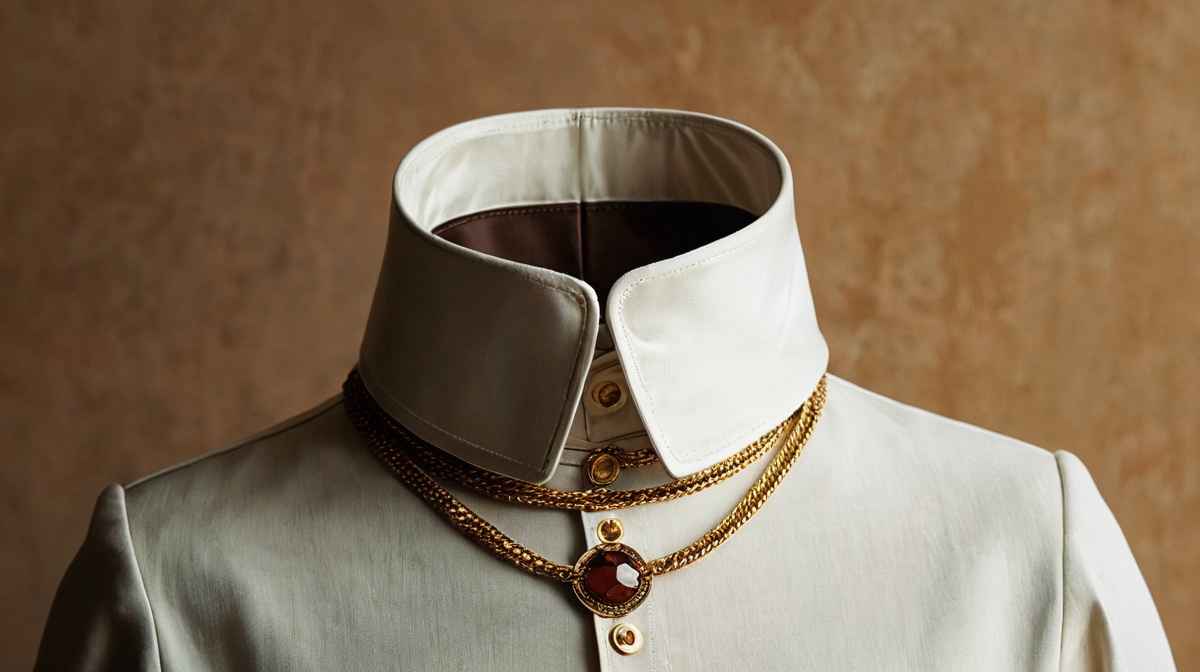
The portrait study The band at the throat was made to run this list against a single image. It turns the face away so the eyes cannot settle anything, and leaves only fit, fastening and the fact that the same silk turns up twice more in the costume.
Questions readers ask
How do you tell a collar from a necklace in a painting?
Fit, mostly. A necklace hangs away from the body and follows gravity, and its shape is decided by the chain. A collar sits against the throat and holds a shape of its own, which means the painter had to describe a rigid or semi-rigid object in contact with skin. That contact is the whole difference. One thing is worn on a person and the other is worn against them.
When did collars start meaning something erotic in pictures?
Later than most people assume. For most of the historical record the band at the throat is about property, service or rank, and the erotic reading arrives properly in the twentieth century through subcultural dress rather than through fine art. What the older pictures supply is the grammar. By the time the modern collar appears it is quoting several centuries of images in which a marked neck meant somebody had a claim.
Does the collar always indicate the subordinate figure?
No, and the exceptions are the interesting ones. Klimt puts a wide gold collar on Judith in the picture where she has just taken a man's head. Court portraits put heavy jewelled bands on the throats of the wealthiest sitters in the room. The band marks a claim, and the claim can run either way. What matters is who is understood to have made it.
The conventions did not stay in the museum
Everything described here began with people working out what to do and what to let be seen. That negotiation is still going on somewhere other than a gallery wall.
See where it happens now